

How to Create an EVP That Attracts Top Talent
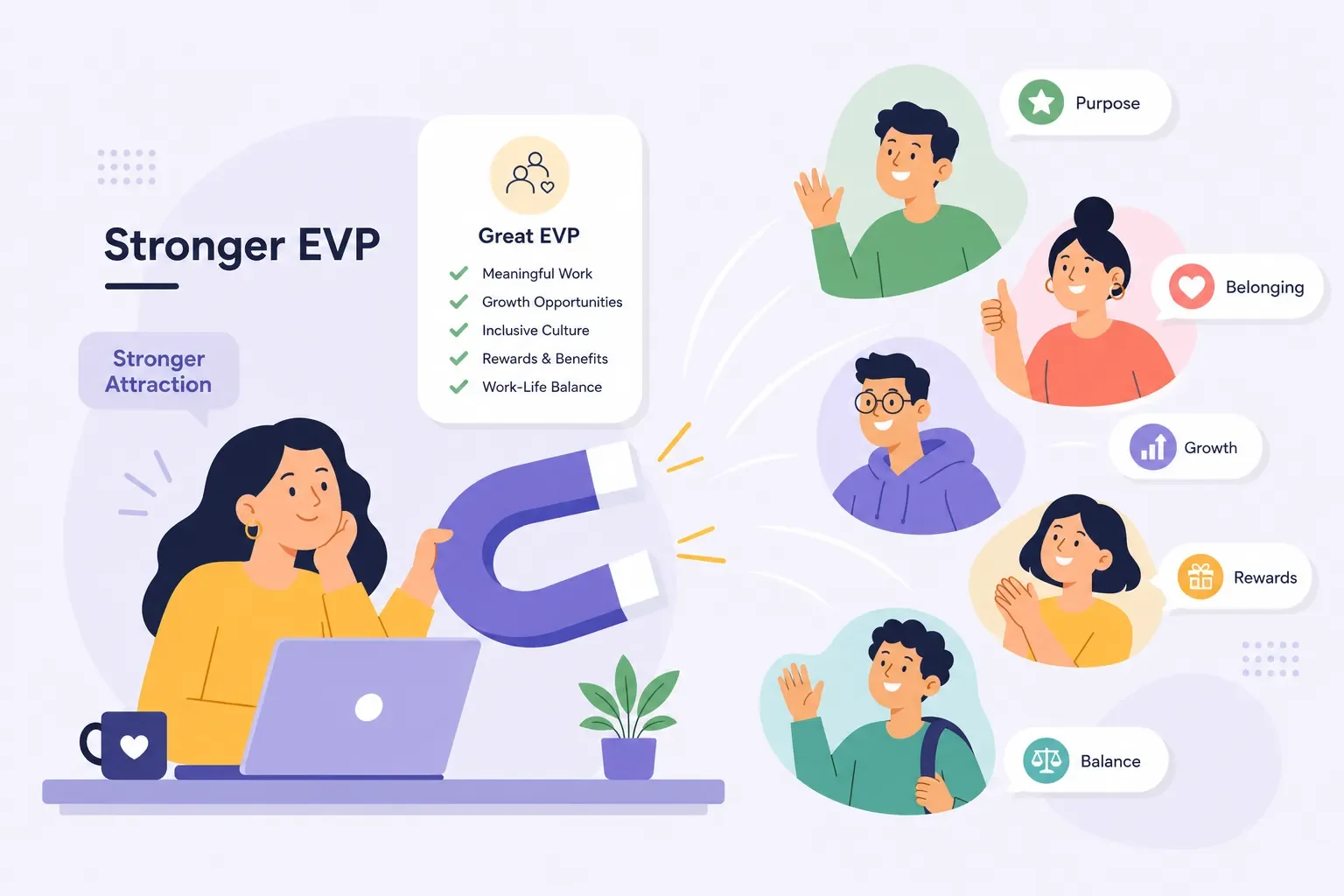
This guide explains how to create an EVP, from listening and benchmarking to message crafting and internal validation, so that HR leaders in India can build an employer proposition that top talent actually believes. Building an employee value proposition that works follows four core steps: listen to employees and candidates, benchmark against competing employers, craft a clear promise with genuine proof points, and validate it internally before you go live. Most EVPs fail not because of poor writing but because organisations skip the research entirely and go straight to messaging. The result is a polished proposition that employees don't recognise and candidates don't believe. For HR leaders in India, the cost is direct: higher cost-per-hire, slower offer acceptance, and accelerated attrition in a talent market that is already unforgiving. This guide gives you a structured process, not just a messaging template.
Key takeways
Research before writing: Start with employee interviews, focus groups, and candidate feedback before drafting a single word of your EVP.
Benchmarking reveals real differentiators: Understanding what competitors promise, and where they fail to deliver, shows you which claims are uniquely yours to make.
Proof points over promises: Each EVP pillar needs specific, verifiable evidence to be credible with both employees and candidates.
Validate internally first: Test the draft with employees before any external activation to catch overpromising and build manager buy-in.
Measure to manage: Track offer acceptance, eNPS, first-year retention, and engagement index scores to prove EVP effectiveness over time.
How do you gather honest insights for EVP design?
The EVP process begins with listening, not writing. The most common mistake HR leaders make is starting with what leadership wants to say rather than what employees and candidates actually experience. These two things are often quite different, and that gap is exactly where EVP credibility breaks down.
Start with one-on-one interviews segmented by tenure, level, and function. Run focus groups with critical talent populations. Analyse exit interview data alongside onboarding surveys. Together, these reveal the gap between what was promised during recruitment and what new joiners actually encounter in their first few weeks. If possible, interview candidates who declined your offer: their candour is invaluable and almost always underutilised.
The most diagnostic survey questions are straightforward. Ask employees what they would miss most if they left. Ask whether the organisation delivered on what was promised during recruitment. Ask which benefit or policy matters most to their daily experience. Ask where the external employer message differs from the reality of working there. These questions generate the raw material the EVP is built on, and they surface the specific language that will make your final messaging feel authentic rather than corporate.
How does benchmarking sharpen your employer value proposition?
Listening to internal employees alone produces an inward-facing EVP. To build a talent attraction proposition that stands out in a competitive Indian talent market, you also need to understand what competing employers are promising and, more importantly, where those promises ring hollow.
Benchmarking is not about copying; it is about finding the claims only your organisation can make credibly. Review competitor career sites, Glassdoor and Indeed reviews, LinkedIn job advertising copy, and publicly available culture or engagement data. Map which themes competitors emphasise: growth, flexibility, purpose, compensation, belonging. Then assess how credible those claims appear when weighed against actual employee reviews.
The EVP sweet spot sits at the intersection of three factors: themes that are highly valued by your target talent, consistently delivered by your organisation, and not already claimed convincingly by key competitors. That combination, high importance to talent, high delivery by your organisation, and low ownership by competitors, is a genuine differentiator worth leading with in your messaging.
How to create an EVP message from your research
This is where HR leaders stall. The research is rich, the data is clear, but translating it into a concise, employee-centred promise with real proof points feels overwhelming from the inside. The key is to synthesise your findings into three to five EVP pillars, then write a central EVP statement that holds them together.
Writing the central EVP statement
Understand the difference between a claim and a proof point. "We invest in your growth" is a claim. "85% of our senior hires are internal promotions, and every employee receives an annual learning budget" is a proof point. Attach evidence to every pillar: policy data, engagement survey scores, internal mobility rates, employee stories, and observable leadership behaviour. Specificity is what separates a compelling EVP from generic employer branding language.
EVP examples and templates: a three-pillar framework
A practical EVP framework typically organises your employer promise into three to five pillars, each backed by specific proof points. Below is a simplified three-pillar template with India-sector examples to illustrate how the structure works in practice.
The EVP pillar most companies underestimate: “wellbeing”
Most EVPs treat wellbeing as a benefit bullet point: gym reimbursement, an EAP helpline, and a wellness day. The companies below embed it as a structural commitment that shapes how work is designed, not merely what is available after hours. These are among the clearest sample employee value propositions for organisations looking to build something more durable than a perks list.
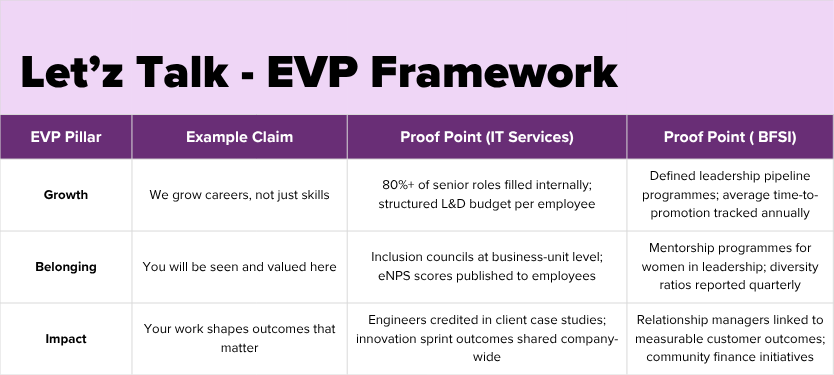
EVP Framework example by Let’z Talk
The same EVP framework applies across sectors, but the proof points must be specific to your organisation. A claim without evidence is simply advertising copy, and experienced candidates in India's IT and BFSI talent markets will test those claims in interviews and on review platforms before accepting an offer.
Why internal validation matters more than most HR leaders realise
An EVP that hasn't been tested is still a hypothesis. Before any external activation, share the draft with the people it describes. Small-group sessions work well: show employees the draft, ask whether it reflects their lived experience, and find out which parts feel aspirational rather than real. Recent hires are especially valuable here because their pre-joining expectations and early reality are both still fresh.
Manager and leadership buy-in is equally non-negotiable. The EVP is reinforced or undermined every day through manager conversations, performance reviews, and how leaders behave under pressure. If leadership hasn't internalised the promise, the EVP will fracture the first time a candidate asks a team member what it's really like to work there. An EVP that employees contradict in casual conversation is not an EVP; it is advertising.
Which KPIs tell you your EVP is actually working?
An EVP without measurement is a document, not a strategy. Establish a 12-month pre-launch baseline, then track results with matched post-launch cohorts to identify real movement. The strongest scorecard combines leading indicators you can check monthly with outcome metrics that tell you whether the EVP is creating genuine business value.
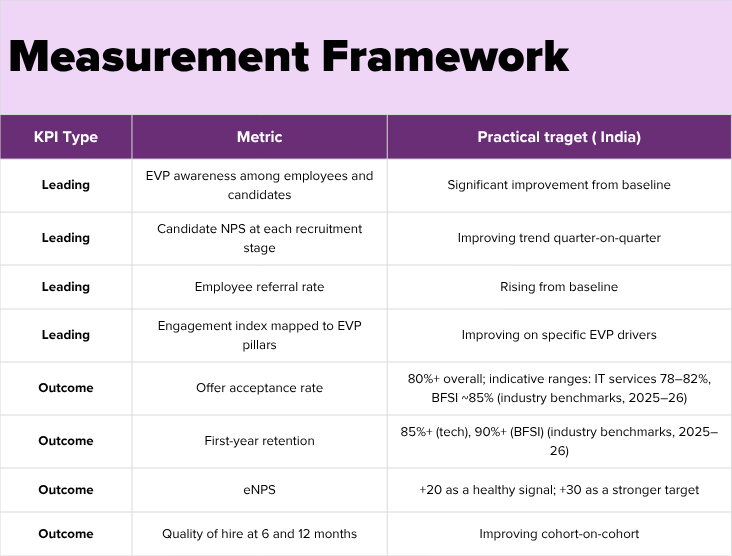
EVP Measurement Framework example by Let’z Talk
The structural pattern across all strong employee value proposition examples is consistent: a clear headline, a small number of signature pillars, and proof points that make each claim verifiable. Without proof, an EVP is just copywriting.
Build an EVP that earns belief, not just attention
Knowing how to create an EVP is the first step. Building one that holds up over time means treating it as a living framework, a genuine employer brand strategy, rather than a launch event. The research should be repeated annually, proof points updated as programmes evolve, and messaging refreshed as workforce expectations shift. A proposition that was credible two years ago can quietly become inaccurate without any deliberate decision to change it.
For HR leaders who want to accelerate this process with an experienced partner, Let'z Talk's free employer brand audit is a practical starting point. It identifies where your current proposition is strong, where it is overpromising, and where the biggest gaps are relative to your talent market. Get in touch with our team to start the conversation.
An EVP built on honest evidence and co-created with employees doesn't just attract better candidates. It makes the promise worth keeping.
Frequently Asked Questions
-
There is no fixed calendar for every organisation; the process begins with listening and should include a 12-month pre-launch baseline for measurement. Start with employee interviews, benchmarking and message crafting, then validate internally before going live so you have comparable pre- and post-launch cohorts to track impact.
-
HR leaders should lead the process, with participation from employees across tenure, level and function, recent hires, managers and senior leadership. Involving these groups ensures the EVP reflects lived experience, secures manager buy-in and catches promises that might otherwise be aspirational rather than real.
-
Prevent overpromising by attaching specific, verifiable proof points to every pillar and by testing the draft with employees before external activation. Use small-group sessions and recent hires to spot aspirational language, and ensure managers and leaders have internalised the promise so everyday behaviour reinforces it.
-
An EVP should be treated as a living framework and revisited at least annually. Repeat the research each year, update proof points as programmes evolve, and refresh messaging as workforce expectations shift so a proposition that was credible two years ago does not quietly become inaccurate.
-
Engage an experienced partner when internal teams struggle to reach clarity or are too close to the material to see authentic differentiators. A specialist partner can accelerate clarity, cut through internal assumptions and offer practical help such as a free employer brand audit to identify strengths, overpromises and gaps relative to your talent market.
-
Let’z Talk helps organizations build an EVP rooted in what employees genuinely experience, value and believe.
We uncover what makes your organization unique through employee insights, research and co-creation.
We turn those insights into a clear, compelling EVP that differentiates you from competitors.
We translate your EVP into authentic messaging that resonates with the talent you want to attract.
The result? An employer brand that attracts the right talent, builds trust and delivers on its promise.
