

Top 10 Workplace Wellbeing Programs That Actually Work
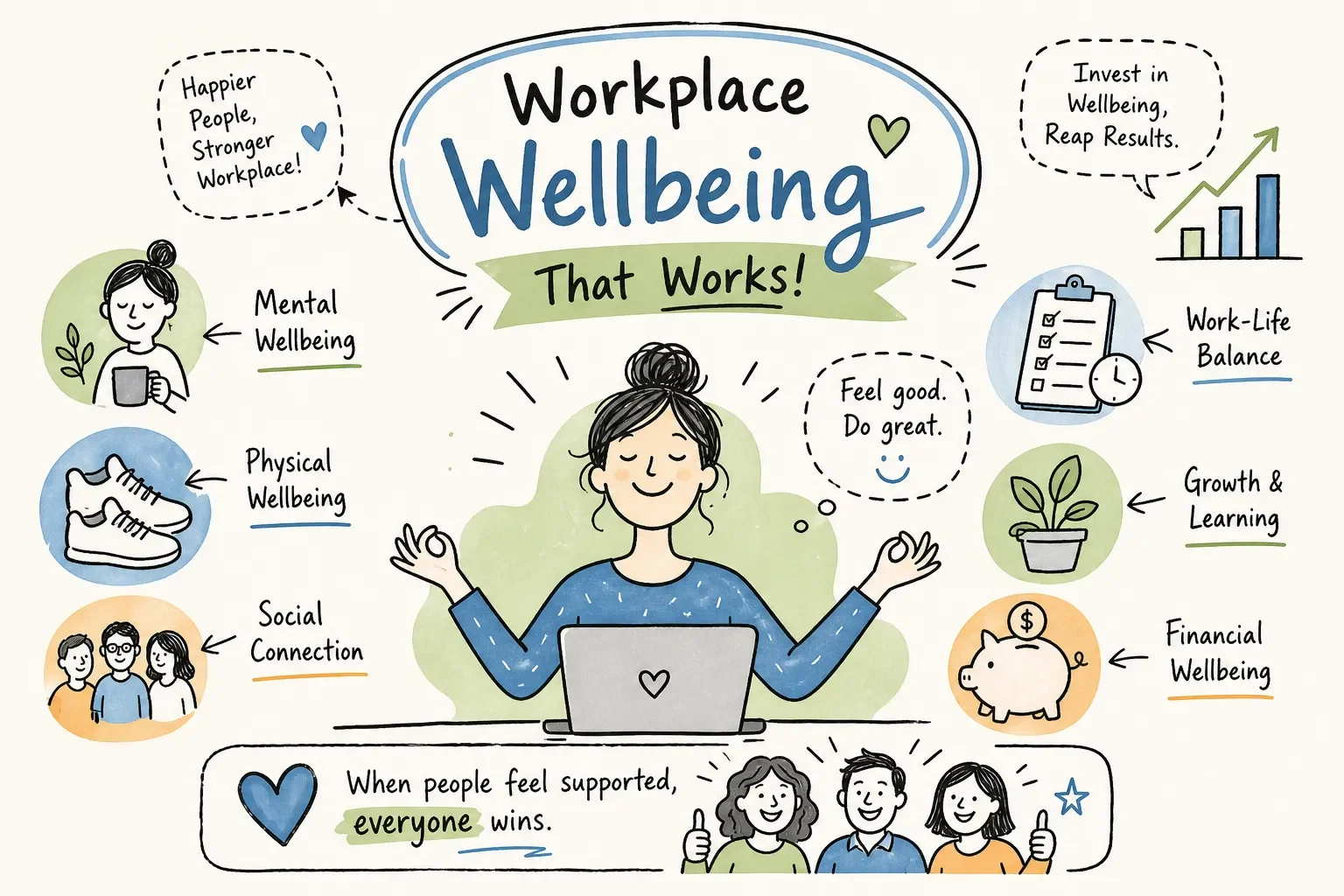
A growing number of Indian companies now run some version of a wellness programme: a yoga session here, a mental health webinar there. Yet disengagement, burnout, and attrition keep climbing. The problem isn't investment; it's strategy. When wellbeing exists as a collection of standalone perks rather than a cultural commitment, it rarely shifts the numbers that matter.
At Let'z Talk, we've observed this pattern across organisations of every size, an internal finding that surfaces consistently during onboarding diagnostics. The fix always starts in the same place: choosing the right interventions and building them into the fabric of how work actually functions. What follows are ten employee wellbeing programmes with the strongest evidence behind them, what outcomes they produce, and how to make them work together rather than separately.
Mental health programmes with the strongest outcomes
These three workplace well-being programs consistently outperform generic wellness activities because they're backed by peer-reviewed evidence. They're not soft initiatives; they're the ones HR leaders should be prioritising first.
1. Employee Assistance Programmes (EAPs): confidential support that actually gets used
A well-structured EAP includes counselling access, legal and financial referral, and crisis support. Utilisation rate is a key KPI to track, with a healthy benchmark sitting between 5% and 10% annually, a range cited across occupational health literature. Underused EAPs are a common failure point across Indian organisations, and communication is frequently why: employees don't know the service exists, don't trust confidentiality, or don't feel psychologically safe enough to use it. When EAPs are actively communicated and properly embedded, the ROI in Indian settings ranges from ₹5 to ₹16 returned for every ₹1 invested.
2. Mindfulness and CBT-based stress management
This is where HR leaders stall. The research is rich, the data is clear, but translating it into a concise, employee-centred promise with real proof points feels overwhelming from the inside. The key is to synthesise your findings into three to five EVP pillars, then write a central EVP statement that holds them together.
3. Resilience training and manager mental health capability
Resilience training alone shows mixed results. The evidence, including WHO and NICE guidance, is clear that pairing it with manager training is what makes the difference. When managers can spot early signs of distress and hold structured, supportive conversations, the whole wellbeing ecosystem performs better. Cluster-randomised trials show this combination produces significant reductions in work-related sick leave. In India, manager enablement typically accounts for around 20% of a wellbeing programme budget, and it's rarely the place to cut.
Structural changes that reshape how work actually feels
Organisational-level changes have a stronger evidence base than individual-level interventions alone and are far less commonly implemented. This is where HR leaders have the most leverage and face the least internal competition
4. Flexible work arrangements
Flexible work is no longer a perk for India's professional workforce; it's an expectation. India-focused research consistently reports that organisations offering flexibility experience significantly better retention, with some studies pointing to improvements in the range of 25% to 50%, compared with those that don't. Flexibility improves autonomy, which is one of the clearest predictors of sustained wellbeing. It also shapes employer brand perception directly: candidates reading Glassdoor reviews and LinkedIn employer content consistently cite work-life balance and flexibility as primary factors in application decisions.
5. Job redesign and workload management
Workload and job design are major contributors to burnout and often require organisational-level fixes rather than only individual-level interventions. Job redesign, redistributing tasks, clarifying role boundaries, and expanding employee control over how work is done, is consistently identified in systematic reviews as effective, particularly when combined with individual support. This is also where a proper wellbeing diagnosis surfaces the highest-impact gaps. The kind of diagnostic work Let'z Talk conducts as part of onboarding regularly reveals that organisations are investing in individual programmes while the structural causes of stress remain entirely unaddressed.
6. Physical activity and occupational health programmes
Workplace physical activity programmes show consistent benefits for reducing stress symptoms and improving general wellbeing scores, but delivery format matters. A gym subsidy alone underperforms compared to supervised group sessions or step challenges with social accountability. Evidence from healthcare-worker studies shows that programmes with a social component consistently outperform solo-activity models, which makes sense given that belonging and peer connection are themselves wellbeing drivers.
Social and financial wellbeing: the programmes most organisations skip…
7 and 8. Peer support networks and team social wellbeing
Peer networks, group coaching, mentoring, and structured team-building activities show measurable improvements in engagement and reduced perceived stress, particularly in remote and hybrid environments. The outcome is less about clinical metrics and more about belonging, which is a direct retention driver. These programmes also strengthen psychological safety, which determines whether employees will use any of the other support on offer.
9 and 10. Financial wellbeing support and return-to-work pathways
Financial stress is one of the least-addressed contributors to presenteeism in India. Basic financial literacy workshops or access to salary-advance tools may help reduce anxiety-related productivity loss, though the evidence here is still developing and effects are often indirect. Return-to-work programmes, structured pathways for employees coming back after mental health-related leave, show particularly strong evidence: one 2024 India case study reported unplanned absence days per employee falling from 7.8 to 5.1, a 35% reduction, with an estimated 4:1 ROI.
Why treating these as separate perks is the biggest mistake
Most organisations implement two or three of these programmes without connecting them. They launch, get celebrated internally, and are often underused or quietly dropped when budgets tighten. The reason is consistent: programmes without cultural anchoring have no staying power.
This is where the Employee Wellbeing Value Proposition (EWVP) framework makes the difference. In plain terms, EWVP is the process of aligning what an organisation does for employee wellbeing with how it communicates its employer brand, both internally and externally. When wellbeing is woven into culture and articulated clearly, it attracts candidates already aligned with those values. It also gives existing employees a shared language for what good looks like. Tata Steel's "Mann Ki Baat" initiative is a widely cited reference point: by embedding mental health support into culture rather than offering it as a standalone option, the programme reportedly achieved over 80% participation alongside measurable improvements in morale and turnover, according to company-published data.
Consider the difference between a mid-size company that offers all ten programmes but where only 20% of employees know they exist, versus an organisation where wellbeing is part of onboarding, referenced in leadership communications, visible on the careers page, and measurable through quarterly pulse scores. The difference isn't budget; it's intentionality.
This is the strategic work Let'z Talk does alongside HR leaders and CHROs: not delivering a programme list, but building the frame that makes each programme meaningful. A free employer brand audit is a practical first step for any HR leader who wants to understand where their current wellbeing communication is falling short.
The bottom line
These ten workplace wellbeing programmes work when they're selected based on evidence, resourced appropriately, and connected to a larger cultural story. The organisations seeing the strongest retention and engagement results aren't necessarily spending the most. They're the ones treating wellbeing as a strategic priority rather than a scheduling exercise.
If your organisation is ready to move from a list of programmes to a genuine people-first culture that shows up in your employer brand, that's the strategic conversation Let'z Talk is built for. Get in touch with our team to start.
