

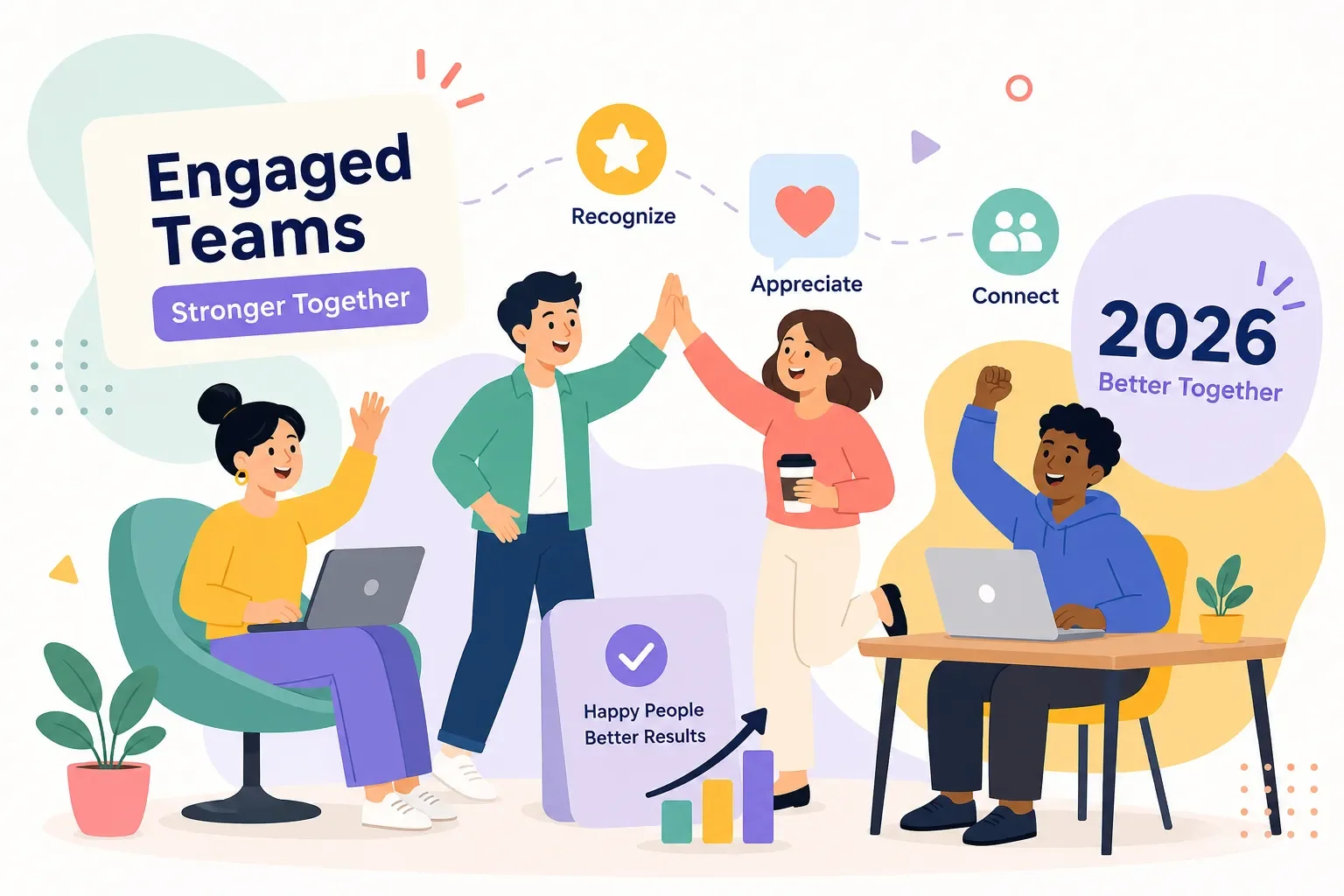
These 20 employee engagement ideas fall into four categories: recognition, wellbeing, career development, and belonging. These are commonly the areas where engagement breaks down in Indian organisations, and addressing them in combination is more effective than running a single initiative in isolation.
According to Gallup's Rebuilding Indian Workplaces for the Future Report, only 23% of Indian employees were engaged in 2025, down from 30% in 2024, with disengagement costing India approximately $351 billion in lost productivity. Most ideas in this list are supported by case studies, published research, or vendor data; where possible, we cite those sources directly.
The engagement activities with the most lasting impact are the ones woven into how an organisation communicates its culture every day, not the ones that appear once a year on an engagement calendar. That distinction shapes how we've built this list.
Key takeaways
Recognition must be specific: Generic praise does not move engagement. Tie recognition to a named behaviour, its impact, and the company value it reflects.
Wellbeing needs visible leadership: Programmes that leaders do not visibly participate in rarely reach the employees who most need them.
Career stagnation drives exits: Great Place to Work India found that 38% of employees are actively looking for a new role, with 70% of those expecting to leave within 12 months.
Belonging is logistical, not just cultural: In India's diverse workforce, inclusion requires intentional choices about food, scheduling, language, and accessibility at every event.
Measurement starts at day 0: Establish a baseline before you launch any initiative, or you won't be able to prove what changed.
Start with 6–8 ideas, not 20: Depth of implementation matters more than breadth. Choose what fits your team's current reality and assign a clear owner to each.
Employee engagement ideas for recognition: making employees feel genuinely seen (ideas 1–5)
What does meaningful recognition actually look like in a hybrid team?
Meaningful recognition is specific, timely, and tied to company values. "Great job" is not enough, it tells the recipient nothing about what they did well or why it mattered. When Subex introduced structured peer recognition without increasing its rewards budget, overall engagement rose 32% and appreciation activity increased 4.2x within two months, according to Awardco. The difference between peer-to-peer, manager-to-employee, and values-based formats matters: each surfaces a different kind of contribution, and hybrid teams need all three.
The five employee recognition ideas to implement first
Start here before adding anything more complex. These five formats are low-cost, asynchronous-friendly, and proven to work across distributed teams.
A dedicated peer kudos channel in Slack or Microsoft Teams, with values-based prompts that guide employees to name the specific behaviour and its impact.
A "win of the week" thread, rotated across teams so that every function gets visibility and no single group dominates the narrative.
Manager appreciation letters that name the specific contribution, the colleague or client it helped, and its business impact. Short is fine; specificity is non-negotiable.
A monthly peer-nominated values award with transparent criteria and nominations open to everyone, not just managers.
Automated milestone recognition for work anniversaries, certifications, and onboarding completions, keeping personalised messages reserved for meaningful contributions.
Asynchronous formats are essential for hybrid teams. Office-based rituals exclude remote employees by default, and that exclusion erodes the sense of belonging you're trying to build. For remote colleagues especially, these small, consistent signals of acknowledgement carry disproportionate weight.
Bryan Furtado, Co-founder & CEO, Let’z Talk
Wellbeing employee engagement ideas that go beyond a yoga subscription (ideas 6–10)
Ideas 6–10: What actually moves the needle on employee wellbeing
The wellbeing activities with documented outcomes are not the most expensive ones. They are the ones with consistent leadership participation, a clear owner, and a way to measure uptake.
Flexible scheduling with genuine supervisor support: Giving employees control over start times and reducing work-family conflict has been associated with improved sleep and mental wellbeing in workplace studies.
Visible mental health days: When leaders take and openly acknowledge mental health days, stigma drops and utilisation rises. Policy alone does not achieve this.
Structured weekly 1:1s with a consistent format: A regular check-in with a manager is one of the highest-signal wellbeing interventions available, and it costs nothing.
An anonymous pulse survey on psychological safety, run every six to eight weeks: this gives employees a voice without requiring them to self-identify, which matters in hierarchical workplace cultures.
A buddy onboarding programme that extends beyond the first week. Early connection reduces isolation and accelerates belonging for new joiners, especially those relocating or joining remote-first teams.
According to Cisco's 2025 Global Hybrid Work Study, 81% of surveyed employers, including those operating in India, reported higher retention under hybrid policies that prioritised wellbeing. Flexibility and manager behaviour are doing more heavy lifting than most formal wellness programmes.
Are your wellbeing benefits reaching the people who actually need them?
Many organisations offer wellbeing perks that only benefit employees who already feel psychologically safe enough to use them. Auditing accessibility means accounting for India's diverse workforce: dietary needs, festival calendars, regional differences, and physical accessibility at events all determine whether your wellbeing investment actually reaches the people it's designed to serve. Offer alternatives rather than requiring participation in any single format.
Career development activities that stop the quiet quitting cycle (ideas 11–15)
Ideas 11–15: Growth that employees can see and feel
Career stagnation is a primary driver of voluntary exits. Great Place to Work India found that 38% of employees are actively looking for a new role. Of those, 70% expect to leave within 12 months, a signal that progression gaps compound quickly into attrition risk. These five activities make progression visible and accessible without requiring a large L&D budget.
Internal lunch-and-learn sessions led by employees: Peer-led learning builds cross-team connection and gives subject-matter experts visibility that formal training rarely provides.
Formal mentoring pairings with regular check-in milestones: Structure matters. Research supports scheduling check-ins every 30–90 days to maintain momentum; pairings without structured milestones tend to lose momentum early.
A transparent internal job board with clear progression criteria: Employees who can see a path forward inside the organisation are less likely to look for one outside it.
A personal learning budget: Even a modest amount signals that the organisation is investing in the individual, not just extracting output.
"Ask an expert" threads in team channels with rotating subject-matter owners: This surfaces internal expertise, reduces silos, and gives contributors recognition without requiring them to run a formal programme.
Why career development is an employer brand story, not just an HR programme
Organisations where employees can see their own growth story reflected in the company's external narrative retain talent more effectively than those that treat development as an internal HR exercise. This is where internal communication strategy, employer branding, and engagement intersect, and it's an area where the internal experience must come first, long before any external story is told.
Belonging strategies for India's hybrid, diverse workforce (ideas 16–20)
Ideas 16–20: Team-building ideas that create connection without forcing it
Belonging is not a single team-building event, it is a sustained experience of being known, included, and valued in the day-to-day. In India's hybrid workforce, where colleagues may be distributed across cities and time zones, that experience requires intentional design. These five activities build it without requiring a large event budget or mandatory participation.
Monthly random coffee pairings across departments: A 45-person SaaS company using this approach saw an 18-percentage-point engagement increase over six months and a 34% rise in cross-department projects, according to Engagedly.
A rotating "team spotlight" format: Surface individual stories, career paths, and expertise from across the organisation to reduce the invisibility that many non-leadership employees experience.
Inclusive cultural celebrations with opt-in participation: Acknowledge Diwali, Eid, Onam, Pongal, Christmas, and regional holidays with food and activity choices that reflect genuine diversity rather than a single cultural lens.
A psychological safety ritual in team meetings: One structured "what's on your mind" moment before agenda items signals that the team is a safe space for honesty, not just task delivery.
An employee-led interest group programme: Books, fitness, sustainability, and photography groups with a small discretionary budget give employees autonomy, cross-functional connection, and a sense that the organisation sees them as a whole person.
What inclusion actually looks like beyond diversity checkboxes
Belonging is both cultural and logistical. At events, offer clearly labelled vegetarian, vegan, Jain, and halal options; avoid requiring participation in religious activities; and schedule within reasonable working hours at accessible venues. India's workforce is too varied to treat any single celebration format as universally welcoming. Build the checklist into every event proposal, not as a compliance step, but as a design standard.
How do you know if any of these employee engagement ideas are actually working?
A simple 30–90 day measurement dashboard
Four primary KPIs are enough for most managers to track without specialist tools. Set a baseline before you launch anything: that's day 0. At day 30, check adoption. At day 90, assess impact.
Set targets before you launch, not after. As an illustrative benchmark, aim for an 8-percentage-point increase in favourable engagement responses, 75% participation, and 70% of employees receiving recognition by day 90, then pair every metric with an owner and a follow-up action, or the data will sit in a dashboard and drive no decisions.
Three signs your engagement strategy needs a rethink
Watch for low participation despite ideas that look good on paper, recognition flowing only from manager to employee and never between peers, and engagement scores that stay flat despite increased wellbeing spend. These three signals point to an internal communication gap, not a programme gap. The ideas are not the problem; the way the organisation is talking about them internally is. Workplace engagement strategies need to be embedded in how teams communicate their culture every day, not treated as standalone events that sit outside normal working life.
Build the culture before you build the calendar
Choose 6–8 employee engagement ideas from this list that fit your team's current reality, assign a clear owner to each, and measure against a 30–90-day baseline. Starting with a focused set, rather than attempting all 20 simultaneously, means deeper implementation, clearer results, and less risk of participation fatigue. These are remote engagement activities and in-person formats alike; what matters is consistency, not venue.
The organisations that sustain high engagement are not running more programmes. According to Gallup, organisations with strong, caring leadership achieve 93% retention compared with 78% among those in the bottom quartile. These are organisations building a culture that communicates itself, both internally to employees and externally to candidates. That is the foundation of a genuine employer brand, and it starts with the internal experience long before it shows up on LinkedIn or Glassdoor.
For organisations ready to look at that bigger picture, a free employer brand audit from Let'z Talk is a practical starting point. Let'z Talk offers a free employer brand audit to assess current brand positioning.
Frequently Asked Questions
-
Start with 6–8 ideas. Depth of implementation matters more than breadth, so choose what fits your team's current reality and assign a clear owner to each idea to avoid participation fatigue and ensure clearer results.
-
You should set a baseline at day 0 and check adoption at day 30 and impact at day 90. Use the simple 30–90 day measurement dashboard with pulse engagement, participation rate, recognition rate and stay intent or eNPS, and set targets before you launch.
-
Wellbeing programmes need a clear owner and visible leadership participation. When leaders visibly take and acknowledge wellbeing actions, stigma drops and utilisation rises, and programmes with genuine supervisor support tend to reach the people who need them most.
-
No, asynchronous formats and not relying on office-only rituals are essential for hybrid teams. Offer low-cost, asynchronous-friendly formats like peer kudos channels, automated milestone recognition and buddy onboarding so remote colleagues receive consistent acknowledgement and early connection.
-
No, many of the highest-impact activities are low-cost and behaviour-driven. Recognition formats, peer-led lunch-and-learns, structured 1:1s and transparent internal job boards are examples that require modest spend but consistent ownership and measurement to move the needle.
Copyright and Disclaimer All content, information, opinions, views, interpretations, and material expressed or presented in this article are the intellectual property of Let’z Talk and are published solely in the name and on behalf of Let’z Talk. All rights are reserved. The views and opinions expressed herein are those of Let’z Talk alone and do not necessarily represent, reflect, or imply the views, positions, or endorsements of any other individual, organisation, client, partner, or third party, unless expressly stated otherwise. No part of this content may be reproduced, distributed, modified, or republished without the prior written consent of Let’z Talk.
