

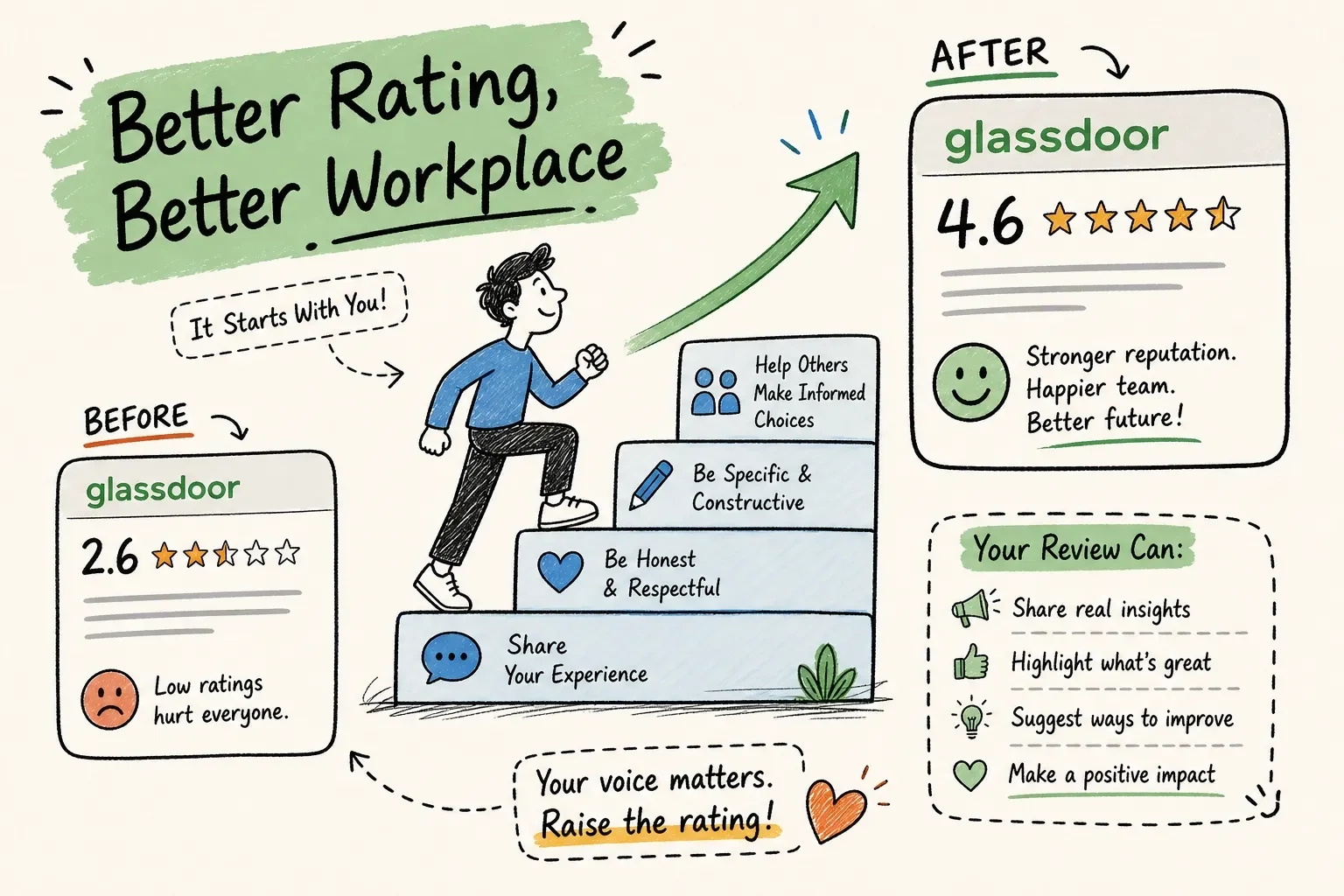
To improve your Glassdoor rating authentically, work through five steps in this order: diagnose the cultural root causes behind negative reviews, claim and complete your employer profile, invite genuine reviews at the right moments, respond to every review professionally, and track internal metrics alongside your public score. Skipping root-cause fixes in favour of volume-driven tactics risks short-term optics rather than lasting improvement.
Glassdoor weighs recent reviews more heavily than older ones, according to Glassdoor. This means fixing underlying workplace issues is both the ethical choice and the most reliable way to produce sustained improvement in your score. What follows is a clear, compliant action plan your HR team can implement immediately.
Key takeaways
Root causes first: Negative reviews cluster around compensation fairness, management quality, career progression, and culture. Fix these before chasing review volume.
Complete your profile: Glassdoor recommends completing all available profile fields, logo, locations, and "Why work for us" content, to give candidates the professional context they need before reading reviews.
Invite, never incentivise: Glassdoor permits voluntary review invitations at natural milestones; offering rewards or applying pressure violates policy and risks account action.
Every response counts: Your reply to a review is read by future candidates, not just the original reviewer. Keep it brief, specific, and professional.
Internal metrics lead public scores: Glassdoor's displayed rating can take up to seven business days to update. Track engagement and exit data as your leading indicators.
Why are employees leaving negative reviews in the first place?
Negative Glassdoor reviews almost never emerge at random; they cluster around systemic gaps in compensation fairness, management quality, career progression, and culture. According to hrbrain.ai's analysis of over 100,000 Glassdoor reviews, compensation issues appeared in 48% of companies, work-life balance concerns in 46%, management problems in 26%, and career development gaps in 20%. These are not isolated complaints, they reflect organisational patterns the company has not yet addressed.
A single low-rated manager or an opaque promotion process can generate enough recurring feedback to drag an entire rating down. Across Indian companies in tech, healthcare, and finance, these themes recur consistently: slow career growth, below-market pay, inconsistent leadership, and unsustainable work pressure dominate the negative review landscape.
How Let'z Talk's Well-Being Diagnosis helps you find the blind spots
Before you can improve your Glassdoor rating, you need to know exactly what is broken. Let'z Talk's Well-Being Diagnosis evaluates company health across culture, engagement, and work environment, mapping the precise gaps that drive poor employer ratings. Rather than guessing from review themes alone, it surfaces the structural issues so HR leaders can prioritise what to fix first.
How to improve your Glassdoor rating: profile and reviews
How to claim your profile and verify ownership
Search for your company on Glassdoor and select "Claim your free Employer Profile." Register with a corporate-domain email, submit your role and department details, and wait for Glassdoor's approval. HR, marketing, operations, and executive personnel are typically eligible for account access, according to Glassdoor. Indian branches, franchises, and subsidiaries must obtain corporate authorisation from the parent entity before proceeding. If the profile is already managed by someone else, request an access transfer; creating a duplicate listing only fragments your review history and confuses candidates.
What to complete in the Employer Centre once verified
After approval, complete every available profile field: logo, company description, office locations by city, sector, employee count, mission statement, and "Why work for us" content. Glassdoor recommends completing all available profile fields so that candidates have the professional context to evaluate you fairly. A complete, accurate profile also allows you to frame your ratings for prospective hires who are actively comparing you against other employers.
How do you build a review culture without gaming the system?
What Glassdoor's policies actually allow in 2026
Employers may invite honest, voluntary reviews at natural employment milestones, including onboarding, performance reviews, anniversaries, and exit interviews. What Glassdoor explicitly prohibits is equally clear: offering incentives of any kind, selectively targeting only satisfied employees, requiring reviews on company devices, and pressuring employees to submit. Glassdoor can remove all contributions linked to a violating account, so the short-term rating lift from manipulation carries consequences that far outweigh any benefit.
The right moments to invite genuine reviews
Four high-response, low-pressure moments work consistently: after onboarding, following a promotion or milestone, during annual performance cycles, and at exit. Keep the invitation neutral ("We'd value your honest perspective") and explicitly voluntary. Trust that leadership reads and acts on feedback tends to increase voluntary participation over time, without any pressure from your side.
How should you respond to Glassdoor reviews to build trust with candidates?
The three As framework for negative reviews
Glassdoor recommends a three-step structure for responding to negative reviews: acknowledge the concern, articulate relevant context using facts without being defensive, and advise prospective candidates on what the company is doing about it. Keep responses brief, specific, and respectful. Never attempt to identify the reviewer, never reference legal action, and always invite private follow-up for unresolved issues. The response is read by future candidates far more than by the original reviewer, so write with that audience in mind.
Responding to positive reviews and what HR should never do
Positive reviews deserve personalised responses too. Glassdoor recommends personalising responses by referencing a specific detail from the review, this is more credible than a generic "thank you." The hard limits apply equally to positive and negative responses: no arguing, no generic boilerplate, no disclosing confidential personnel information, no unapproved promises, and no asking reviewers to remove or alter their review.
Tracking progress to improve your Glassdoor rating: how do you know the work is paying off?
Internal metrics that predict rating improvement
Glassdoor's displayed rating can take up to seven business days to update after new reviews are approved, according to Glassdoor. HR teams cannot wait for the public score to move before assessing whether the work is having an effect. Track recurring review themes quarterly alongside engagement survey scores, exit interview data, manager effectiveness ratings, and promotion-access metrics. When internal metrics improve, the Glassdoor score follows consistently; the reverse is rarely true.
How Glassdoor's algorithm rewards recent improvements
Glassdoor's recency weighting means that a consistent stream of genuine, high-rated reviews from a genuinely improved workplace will gradually lift the overall average. For companies with smaller review pools, the movement is more visible per review. Set a quarterly review cadence to assess whether the cultural changes are showing up in both internal data and new employee feedback, and use that cadence to decide where to invest next.
Working to improve your Glassdoor rating is not a reputation management exercise; it is a culture improvement exercise that happens to be visible externally. The companies that see sustained improvement start by diagnosing what is actually broken and working through structural fixes before worrying about review volume or profile aesthetics. Chasing the score without addressing the root causes produces a temporary lift and very little else.
If you are not sure where your culture gaps actually lie, Let'z Talk's free employer brand audit is a practical starting point. Let'z Talk's free employer brand audit assesses current brand positioning. Get in touch with our team to request yours.
Frequently Asked Questions
-
You should expect Glassdoor's displayed rating to take up to seven business days to update after new reviews are approved, and we advise tracking internal metrics sooner as leading indicators. Track engagement scores, exit interview data and other internal measures rather than waiting only for the public score to move.
-
You should monitor recurring review themes quarterly alongside engagement survey scores, exit interview data, manager effectiveness ratings and promotion-access metrics, and we consider these the leading indicators that predict public score improvement. When these internal metrics improve, the Glassdoor rating typically follows, so use them to decide where to invest next.
-
You should invite employees at natural milestones, after onboarding, following promotions or milestones, during annual performance cycles and at exit, and we recommend keeping every invitation neutral and explicitly voluntary. Trust that leadership acts on feedback will increase voluntary participation over time without any pressure from your side.
-
You should request an access transfer rather than creating a duplicate listing, because duplicates fragment your review history and confuse candidates, and we recommend obtaining corporate authorisation for branches, franchises or subsidiaries before proceeding. Register for claim only with a corporate-domain email and wait for Glassdoor's approval if you do not yet have access.
Copyright and Disclaimer* All content, information, opinions, views, interpretations, and material expressed or presented in this article are the intellectual property of Let’z Talk – a Turia Advisors LLP and are published solely in the name and on behalf of Let’z Talk. All rights are reserved. The views and opinions expressed herein are those of Let’z Talk alone and do not necessarily represent, reflect, or imply the views, positions, or endorsements of any other individual, organisation, client, partner, or third party, unless expressly stated otherwise. No part of this content may be reproduced, distributed, modified, or republished without the prior written consent of Let’z Talk.
